
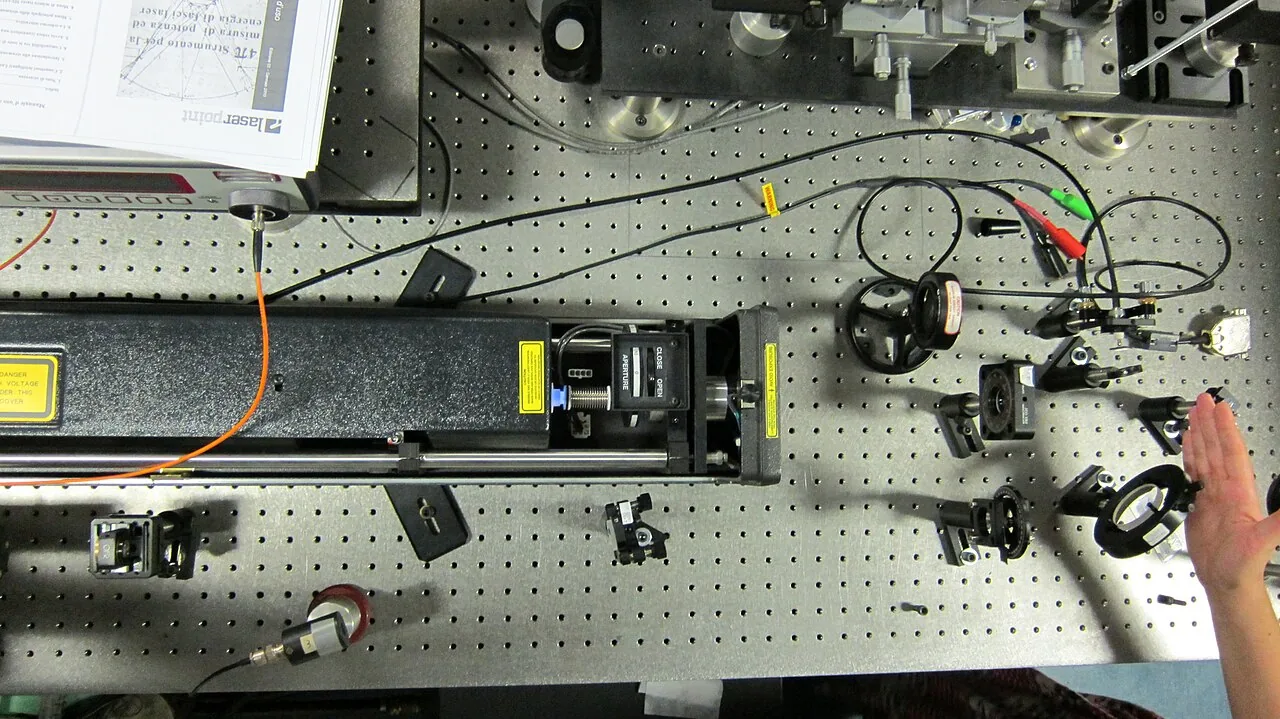
An optical table seen from above. Photograph by Giorgio Brida, 2010. Giorgio Brida from Torino, Italy · CC BY 2.0
External editorial reference; not a SUM VISUM facility or project. Credits & changesSUM LABS
Build enough to answer the question.
Before investing in a product, a team needs to know what can work and what still needs investigation. SUM LABS turns technical questions into feasibility studies, prototypes, functional tests and documented engineering decisions.
Archival prototype / NASA JPL
A small object can test a substantial question.
An archival active-pixel-sensor prototype, shown in a hand for scale, makes the boundary between concept and physical evidence visible. SUM LABS uses that distinction as a method: define the uncertainty, bound the prototype and document what a test can establish. This is an external historical example, not a SUM VISUM product.
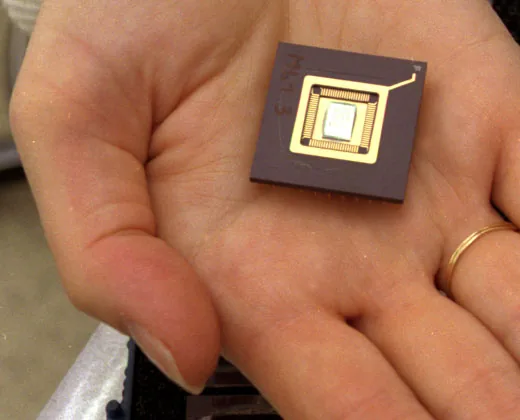
Archival NASA/JPL active-pixel-sensor prototype held in a hand. External historical reference. NASA / JPL (uploaded by Michael Schmid) · Public domain
External editorial reference; not a SUM VISUM facility or project. Credits & changesSUM LABS / Professional services
Services and deliverables
01
Product research & development
Investigate technical feasibility, user requirements and design constraints before committing to a product build.
- Deliverable
- Research brief, technical feasibility findings and evidence-based product decision options.
Active professional service
Discuss this service02
Rapid prototyping & MVP development
Build bounded prototypes and minimum viable products with explicit test criteria, engineering assumptions and a handover plan.
- Deliverable
- Versioned prototype/MVP, prioritized backlog, acceptance tests and handover with known limits.
Active professional service
Discuss this service03
Applied technology research
Review available methods, compare options and record reproducible experiments tied to a practical decision. Research does not guarantee a commercial result.
- Deliverable
- Experiment protocol, reproducible findings and technical comparison report.
Active professional service
Discuss this service04
Hardware & IoT innovation
Scope sensing, device and physical prototype studies through suitably equipped partners. Equipment, partner availability and safety requirements must be established.
- Deliverable
- Device/IoT concept, interface specification and partner/tooling feasibility study; no manufacturing claim.
Active professional service
Discuss this service05
Product testing & validation
Develop functional, usability and reliability test plans, evidence logs and defect reports. This is not accredited laboratory testing or regulatory certification.
- Deliverable
- Test plan, functional/usability evidence, defect register and validation limitations.
Active professional service
Discuss this service06
Innovation partnerships & co-development
Define research questions, contribution boundaries, intellectual-property arrangements and milestones before collaborative development starts.
- Deliverable
- Co-development scope, responsibility/IP questions, milestones and feasibility review.
Active professional service
Discuss this service
Delivery / evidence
Client value and delivery
The customer problem
Product ideas with unresolved feasibility, usability or engineering assumptions.
Intended outcome
A documented experiment or prototype that supports a clear next decision.
How acceptance is agreed
Agree hypotheses, prototype boundaries, test method and success/failure criteria before building. Record observations and defects; hand over reproducible instructions and a go, revise or stop recommendation.
Delivery prerequisites
Technical personnel, tools, intellectual-property terms and test conditions must be confirmed. Physical prototyping needs suitably equipped resources or partners confirmed for that project.
Example: prototype decision record
Hypothesis → test inputs → observable result → limitation → next decision. Use synthetic inputs and repeatable steps. This is an experimental format, not evidence of an equipped laboratory or accredited testing facility.
01 / Purpose
Use prototypes and documented tests to resolve the technical questions behind product decisions.
The operating context
A concept becomes useful when its uncertainties are specific. Can the workflow survive a lost connection? Does the model cite the right source? Can a person complete the task? SUM LABS gives those questions an engineering form before scale becomes a commitment.
A closer reading
Make the uncertainty observable.
Alignment, instrumentation and controlled inputs determine what a test can establish. SUM LABS connects prototype engineering with a record of assumptions, observations and failure cases, so another division can understand what has—and has not—been demonstrated.
02 / Evidence & evaluation
From definition to validation
Each experiment needs a hypothesis, a baseline, success and failure criteria, and a record of limitations. A negative result can narrow a product decision. Reproducibility and clear handover matter more than presenting every prototype as a breakthrough.
State the hypothesis, baseline and acceptance criteria.
Build a bounded prototype and record its behaviour.
Review the evidence and decide whether to revise, stop or advance.
03 / Domain architecture
Strategic scope describes the division’s field. Products and initiatives have their own development status; no unannounced service or product is offered.
- 01
Experimental engineering
Proofs of concept isolate a technical question: a data flow, device constraint, interface or integration. A bounded prototype should reveal dependencies and failure modes, with documentation sufficient for another person to inspect the result.
- 02
AI and interaction experiments
Research covers model behaviour, retrieval, language, human review and the interface between a system and its user. Baselines and representative tasks help distinguish an attractive demonstration from a repeatable result.
- 03
Cross-division product validation
A health reference tool, field record or learning workflow can share components without sharing every risk. Validation must preserve domain-specific criteria, data boundaries and the authority to decide what is ready for a next stage.
- 04
A prototype needs an exit criterion
Experiments should isolate one uncertainty: sensor reliability, retrieval quality, synchronisation or user comprehension. The test record needs a baseline, controlled inputs, failure cases and reproducible steps. The next decision may be to refine, abandon or investigate further; none automatically establishes a production-ready product.
- 05
Engineering the handover
A cross-division prototype should leave a dependency map, data inventory, limitations and an operating-cost estimate. Security review, accessibility, maintenance ownership and domain validation belong in the transition to a release candidate. Research involving people or sensitive data requires an appropriate review process before collection begins.
04 / Intelligence in practice
Evidence before amplification.
AI experiments require versioned inputs, test cases and records of model behaviour. Evaluation includes false confidence, missed context, privacy leakage and failure recovery. Human reviewers define acceptable behaviour for the domain. Synthetic examples can support an experiment, but cannot stand in for evidence from the actual use setting.
05 / Product status
In DevelopmentResearch — experimental prototypes and proofs of concept. A prototype is not a released product, and no catalogue of completed research, validated systems or published results is claimed here.
06 / Access by design
Test the conditions, not only the interface.
Device limits, weak networks, language variation and assistive technologies belong in the test plan. Offline experiments must include interrupted synchronisation and stale data. Research participation and any personal data collection require a separately defined scope and consent process.
Relevant to
- Product and engineering collaborators
- Research groups and technical institutions
- Division teams defining a product question
- Strategic partners assessing technical feasibility
07 / System relationships
Connected divisions
SUMMENSA supplies AI research questions; SUMTECH brings device and infrastructure constraints. SUMAGRI grounds experiments in field operations. Across all nine divisions, SUM LABS provides a method for testing assumptions before wider commitment.




VISIONS INTERLINKED
Your project begins with a conversation.
Tell us the need, the audience and the result you want. Initial contact carries no obligation; terms are agreed before paid work begins.